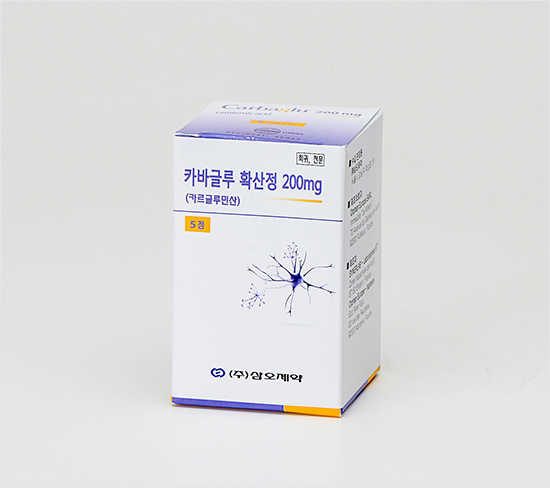
- 카바글루 확산정
- Carbaglu® 200 mg Dispersible Tab.
- Classification
- Metabolic Agents
Indication/Usage
Carbaglu is indicated in treatment of
hyperammonaemia due to N-acetylglutamate synthase primary deficiency.
hyperammonaemia due to isovaleric acidaemia.
hyperammonaemia due to methymalonic acidaemia.
hyperammonaemia due to propionic acidaemia.
Dosage/Administration
For N-acetylglutamate synthase deficiency:
Based on clinical experience, the treatment may be started as early as the first day of life.
The initial daily dose should be 100 mg/kg, up to 250 mg/kg if necessary.
It should then be adjusted individually in order to maintain normal ammonia plasma levels.
In the long term, it may not be necessary to increase the dose according to body weight as long as adequate metabolic control is achieved; daily doses range from 10 mg/kg to 100 mg/kg.
Carglumic acid responsiveness test
It is recommended to test individual responsiveness to carglumic acid before initiating any long term treatment. As examples
- In a comatose child, start with a dose of 100 to 250 mg/kg/day and measure ammonia plasma concentration at least before each administration; it should normalise within a few hours after starting Carbaglu.
- In a patient with moderate hyperammonaemia, administer a test dose of 100 to 200 mg/kg/day for 3 days with a constant protein intake and perform repeated determinations of ammonia plasma concentration (before and 1 hour after a meal); adjust the dose in order to maintain normal ammonia plasma levels.
For isovaleric acidaemia, methylmalonic acidaemia and propionic acidaemia:
The treatment should start upon hyperammonaemia in organic acidaemia patients. The initial daily dose should be 100 mg/kg, up to 250 mg/kg if necessary.
It should then be individually adjusted in order to maintain normal ammonia plasma levels.
Method of administration:
This medicine is for oral use ONLY (ingestion or via a nasogastric tube using a syringe, if necessary).
Based on pharmacokinetic data and clinical experience, it is recommended to divide the total daily dose into two to four doses to be given before meals or feedings. The breaking of the tablets in halves allows most of the required posology adjustments. Occasionally, the use of quarter tablets may also be useful to adjust the posology prescribed by the physician.
The tablets must be dispersed in a minimum of 5-10 ml of water and ingested immediately or administered by fast push through a syringe via a nasogastric tube
- Development Marketing Dept(Product information)
- +82-2-566-7199